Collective Play design, supply and fit out early learning centres — and they are growing fast. The pressure that comes with that is a familiar one: more work, more people, and more of the business held in somebody's head.
Collective Play is a supply and fit-out business — room-by-room kits, inventory, purchasing, margin, and new-centre rollouts run as projects. Every one of those has detail that lives in a person rather than a system, and every one of them gets heavier as the business grows.
The room was deliberately small: Steven, the GM, and Lou, the owner. Just the two of them, on purpose — so the two people steering the business become the two most capable people in it on AI, rather than finding themselves led by whoever on the team got there first.
They were already on Claude, having moved across from Copilot. No Microsoft-house constraint, no data-security lock-in to work around — just a straight run at the best tool for the job.
Steven arrived sprinting. Four months into the GM seat, he turned up with his own five-layer AI framework already sketched out — which tells you everything about how he's approaching the role.
When someone arrives with that much momentum, the temptation is to skip ahead to "so where could we use this?" That question is a trap this early. Answer it before you understand the machinery and you end up with a shiny object every fortnight and nothing that compounds.
So we started underneath it.
Why instructions matter, how files get uploaded, and what a Project actually holds and remembers — just as importantly, what it doesn't.
Where the equivalent instructions, files and settings live in the other camp — so nobody ends up fluent in one vendor's vocabulary and stuck inside it.
The background stuff. Unglamorous, and the reason everything afterwards makes sense.
Steven and Lou spent five minutes talking through a role they're hiring for — an interior stylist — what they actually want in the person, and how the business recruits. Captured with a transcript tool.
Chat, project instructions and files — with that conversation loaded in alongside the position description they already had written.
With the fundamentals in, we spent the rest of the day designing — not building — the thing Steven wanted next: a single meetings "brain" covering his four new key meetings.
One Project, four foundation files: Sales, Purchasing, Individual, Whole Business. Four files inside one project rather than four separate projects. One brain, four facets.
The mechanics are where the real value sat:
Designed, not built. That was the point. It's his to run.
Steven's own read on the day was that the value was the foundation — understanding what this is and what it's actually for. He was open about the pull to leap ahead to "where could we use this", and about deliberately holding himself back from it.
"Align the AI journey with our growth journey — but bring it back to the fundamentals first."
His plan, in his own framing: small trials, mini projects, build the fundamentals, then judge the bigger questions from a position of actually knowing. A word he kept reaching for through the afternoon was "ecosystem" — a mental model forming in real time.
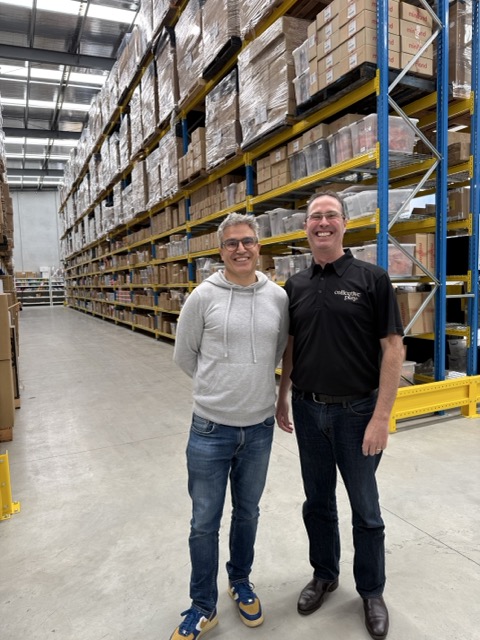
Mark and Steven, in among the racking at Collective Play.
Not everything belongs in one day. Some of it we named and left exactly where it was:
Steven left with a method, not a deliverable. For a business growing at this pace, that is the outcome that matters — because the method is what keeps working after I've gone home.
Take the free AI assessment — a few quick questions, and I'll come back to you personally.
Take the Free AI Assessment →